
Cracked or unsafe pavement is best repaired through professional concrete sidewalk construction, which involves removing damaged sections, preparing a compacted subbase, and pouring high-strength concrete. This approach eliminates trip hazards, ensures proper drainage, and provides a durable, smooth surface that meets local safety compliance standards. By replacing fractured slabs rather than applying temporary patches, property owners ensure long-term structural integrity and enhance curb appeal.
Why Professional Concrete Sidewalk Construction is the Solution
When you notice a jagged gap or a heaved slab, it is more than an eyesore; it is a primary safety risk. While many attempt to fill cracks with store-bought fillers, these are cosmetic fixes that rarely last. True concrete sidewalk construction in Nashville requires a deep understanding of local soil composition and the weather patterns that impact rigid surfaces. A complete reconstruction ensures that the root cause, be it shifting soil or poor initial installation, is fully addressed.
Professional construction creates a transit path designed to withstand heavy foot traffic and outdoor stress. When you opt for a full reconstruction, you invest in a system that includes proper excavation and high-quality materials. This method prevents the “sinking” effect common in older walkways. Beyond immediate safety, new concrete adds measurable value to a property, creating a positive first impression for visitors and customers.
The Construction Workflow
To achieve a result that lasts for decades rather than years, a specific, disciplined sequence must be followed. Skipping even one of these steps leads to premature cracking.
- Demolition and Extraction: The process begins with the physical removal of the old, compromised concrete. Using jackhammers or heavy machinery, the fractured slabs are broken up and hauled away. It is vital to remove the entire failed section to ensure the new pour has a stable start.
- Subgrade Preparation: This is the most critical step in the project. The earth is excavated further to make room for a layer of crushed stone or gravel, which is machine-compacted to create a non-shifting foundation. Without a solid base, even the strongest concrete will eventually sink.
- Forming and Sloping: Using wood or metal forms, the layout is established. A crucial element here is the pitch; to prevent puddling, the sidewalk must have a slight slope to guide water away from the building foundation.
- The Pour and Reinforcement: High-strength concrete is poured into the forms. In certain areas, reinforcement materials such as fiber mesh may be integrated to enhance tensile strength and prevent separation.
- Finishing and Curing: Before the concrete sets, a texture is applied to create a slip-resistant surface. Finally, control joints are cut at specific intervals to manage where the concrete expands and contracts, preventing random fractures.
Comparing Repair Methods: Patching vs. Full Replacement
It is tempting to choose the quickest option when a sidewalk starts to fail. However, understanding the surface’s lifecycle is essential for long-term planning. During a recent project evaluation in East Nashville, it was clear that repeated patching often results in higher cumulative costs than a single, high-quality replacement.
| Feature | Patching/Mudjacking | Full Construction |
| Primary Goal | Temporary leveling | Long-term structural integrity |
| Durability | Short-term (1 to 3 years) | Multi-decade lifespan (20+ years) |
| Aesthetics | Visible seams | Uniform, clean appearance |
| Safety | Reduces minor trips | Full safety & drainage control |
| Maintenance | Frequent updates needed | Minimal intervention required |
While patching might work for a small, isolated chip, it does nothing to address a sinking foundation or a root system that is actively pushing upward. Full construction resets the clock on your property’s infrastructure, providing a clean slate engineered to modern standards.
Common Causes of Sidewalk Failure
Why do sidewalks fail in the first place? For those seeking Nashville sidewalk construction, understanding these factors is the first step toward a permanent fix. Concrete is durable, but it is not invincible against natural forces.
- Tree Root Invasion: Large root systems exert incredible upward pressure, easily snapping standard concrete slabs. Because concrete is strong but brittle, it cannot bend; instead, it snaps, creating the classic heaved slabs that are dangerous to pedestrians.
- Poor Drainage: If water pools next to or under the sidewalk, it erodes the supporting soil, creating voids that cause the concrete to collapse. Proper grading during the construction phase is the only way to prevent this erosion.
- The Freeze-Thaw Cycle: This is a major factor for concrete sidewalks in Nashville, TN. When water enters tiny pores and freezes, it expands, causing the surface to flake or crack. Over several winters, this internal pressure turns small flakes into total structural failure.
- Substandard Mix: If a mix is too thin or contains too much water, the resulting slab is weaker and more porous. This makes it much more susceptible to the elements and heavy use. Professional mixing is non-negotiable for a lasting finish.
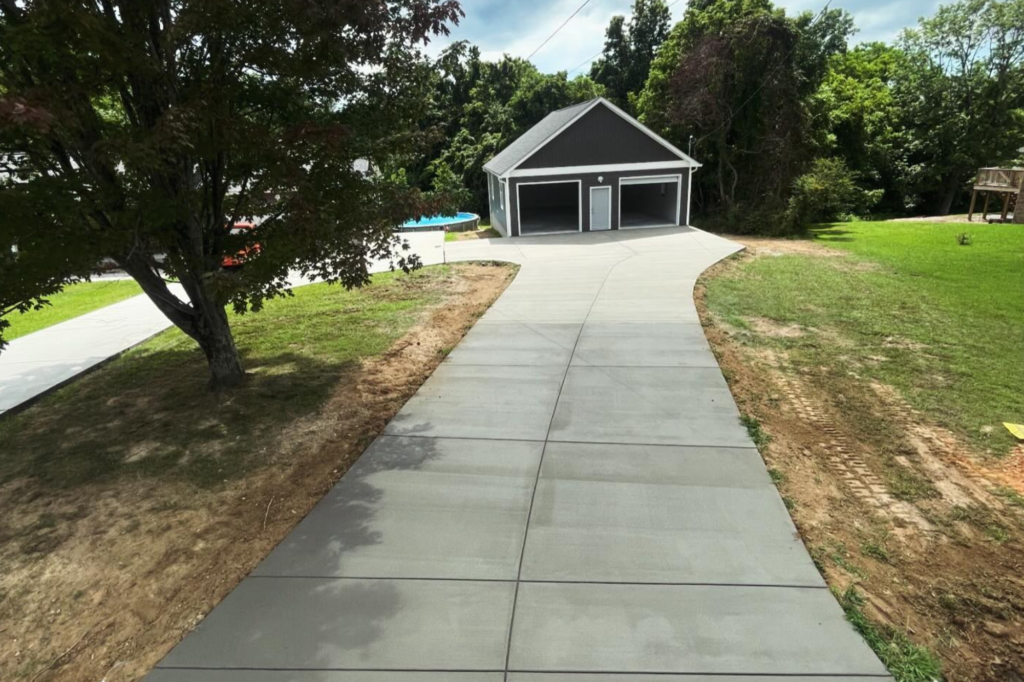
Debunking the “Thicker is Always Better” Myth
A common industry misconception is that simply pouring a thicker slab of concrete, say, six inches instead of four, will prevent all future cracking and shifting.
The Reality: While thickness adds compressive strength, it cannot compensate for a poorly compacted subbase. If the ground underneath shifts or washes away due to poor drainage, even a ten-inch slab will eventually succumb to gravity. We often find in neighborhoods like Sylvan Park that the secret to a permanent sidewalk construction in Nashville is the gravel and dirt underneath. A standard 4-inch slab on a perfectly compacted base will outperform a thick slab poured on raw topsoil every single time.
A Structured Approach to Durable Outdoor Surfaces
To create long-lasting concrete and masonry, a systematic method ensures every section is designed for durability and performance.
Six Key Principles:
- Leveling & Topography: Surfaces are aligned with the landscape to prevent uneven spots and trip hazards.
- Integration: New installations work seamlessly with existing structures, allowing natural movement without damage.
- Thermal Control: Curing is carefully managed to prevent cracking and ensure a smooth finish.
- Moisture Management: Subbase design allows proper drainage, avoiding sinking or structural issues.
- Surface Strengthening: Finishing techniques enhance durability and resistance to wear.
- Protective Coating: A sealer creates a barrier against water and environmental damage.
This approach delivers safe, durable, and visually appealing outdoor areas built to last.
In Summary
Addressing cracked or unsafe sidewalks is essential for safety and property value. Moving beyond temporary patches and using professional construction techniques ensures that walkways remain durable for decades. Every step, from proper subbase preparation to high-quality sealing, is an investment in a long-lasting solution. Trust The Outback Builder, INC. to provide expert sidewalk construction and repairs that stand the test of time. Ensure your sidewalks are safe and long-lasting. Contact us today to schedule an evaluation.
People Also Ask (FAQ)
- How long does it take for a new concrete sidewalk to be ready for use?
Typically, you can walk on a new sidewalk within 24 hours. However, you should wait at least 7 to 10 days before driving a vehicle across it at a driveway apron to ensure it has reached sufficient strength.
- Do I need a permit for sidewalk construction?
In most municipalities, especially if the sidewalk is near a public right-of-way, a permit is required. Professional sidewalk construction in Nashville providers handle the permitting process to ensure the project meets all local building codes.
- What is the best time of year to pour a new sidewalk?
Moderate temperatures are ideal. Extreme heat or freezing temperatures can interfere with the chemical curing process, so we use specific additives depending on the season to ensure a perfect set.